AI-Powered Loan Review Platform
Automating data validation for mortgage loan boarding & servicing
Overview
I led the product design for an AI-powered data validation platform that streamlines the mortgage loan boarding and servicing review process. The platform leverages artificial intelligence to automate the validation of loan data, drastically reducing manual review time while maintaining compliance and accuracy standards.
The Problem
Loan boarding for mortgage servicing requires reviewers to manually validate dozens of data points across each loan file: borrower details, loan type, amounts, compliance flags, and SLA deadlines. The existing workflow was entirely manual, requiring reviewers to cross-reference multiple systems and documents for each loan.
Key Pain Points
Time-intensive reviews: Each loan took an average of 22 minutes to validate, creating bottlenecks during high-volume periods
SLA pressure: Reviewers frequently missed SLA deadlines due to volume, leading to compliance risk
Context switching: Reviewers toggled between 3–4 different tools to gather information for a single review
Error-prone process: Manual data entry and validation led to inconsistencies and rework
Design Process
I conducted contextual inquiries and shadowed loan reviewers to understand their existing workflow. I interviewed operations managers to map out SLA requirements and compliance constraints. This research revealed that the majority of review time was spent on repetitive data checks that could be automated, while reviewers needed to focus their expertise on exception handling and flagged items.
Workflow: Before vs. After
Key Design Tradeoff: Confidence Scores vs. Binary Pass/Fail
Early prototypes used simple pass/fail indicators. During testing, reviewers told us they didn't trust a binary "pass" — they wanted to see how confident the system was. We introduced percentage-based confidence scores (92%, 88%). This increased review time by ~30 seconds per loan but dramatically improved trust and adoption. The tradeoff was worth it: reviewers who trust the tool actually use it.
Key Design Decisions
Centralized Queue View
Consolidated all loan reviews into a single, filterable dashboard so reviewers can prioritize by SLA urgency, loan type, or assignment.
AI-Driven Progress Tracking
Introduced a validation progress indicator (e.g., 12/24 checks complete) so reviewers can see what's been auto-validated vs. requiring manual attention.
Smart Flagging System
Surfaces exceptions and anomalies identified by the AI, allowing reviewers to focus only on items that need human judgment.
SLA Visibility
Color-coded SLA indicators provide at-a-glance urgency cues. Green for complete, orange for approaching deadline.
The Solution
Reviewer Queue
The reviewer queue serves as the primary workspace. It provides a comprehensive view of all assigned loans with real-time progress tracking, SLA status, and quick-access filters. The AI engine runs validation checks in the background, updating progress indicators as data points are verified.
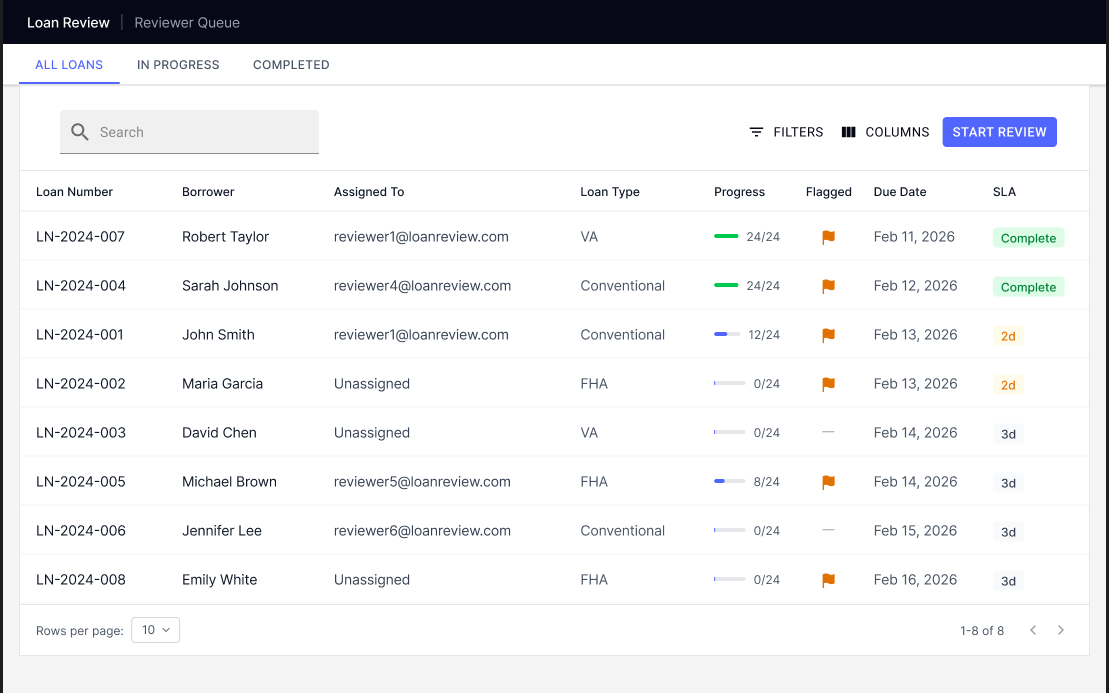
Fig 1. Reviewer Queue. All Loans view with AI validation progress and SLA tracking
Tab navigation: All Loans / In Progress / Completed — filter by status without losing context
Flag indicators: Orange flags mark loans with AI-detected anomalies; unflagged loans passed all automated checks
SLA column with color coding: Green "Complete" badges, orange countdown days (2d, 3d) for at-risk loans
Loan Review Detail: AI-Assisted Rule Validation
When a reviewer clicks "Start Review," they enter the core workspace where AI-powered validation happens. This is the screen most directly responsible for cutting review times from 22 minutes down to 8 minutes. It fundamentally changes the reviewer's task from "find and verify everything" to "confirm or correct what the AI has already checked."
AI Confidence Scores: Each rule displays a confidence percentage (92%, 88%). High-confidence items can be approved quickly; lower scores signal where to invest time. This triaging mechanism is the primary driver of time savings.
Discrepancy Detection: The AI surfaces mismatches between system data and source documents (e.g., "System $78,500/year vs Document $75,000/year"). Yellow alerts draw the eye directly to conflicts.
Source Document Linking: Each data point links to its exact source (e.g., "W-2 Form 2023, Page 1, Box 1, Line 3"). One-click verification eliminates context switching.
Pragmatic Category Separation: Each validation category groups rules tied to a specific document type. All W-2 rules in one category, all pay stub rules in another — reducing cognitive load by letting reviewers work through one source document at a time.
Results & Impact
UX Scorecard: Prioritizing What to Build Next
After launch, we ran usability testing sessions to measure how efficiently reviewers moved through the system. The UX Scorecard captures those metrics — task completion rates, time-on-task, error rates, and satisfaction scores — to identify which features had the highest impact and where to invest next. This data-driven approach ensured our roadmap was shaped by real user behavior, not assumptions.
Interactive prototype loading...
Open in Figma insteadInteractive prototype — click through to explore the full scorecard
Key Takeaways
The AI validation engine handled repetitive, rules-based checks, freeing reviewers to apply expertise on exceptions and edge cases
The centralized queue with SLA visibility eliminated separate tracking spreadsheets and reduced missed deadlines
Strong daily adoption (150+ users) validated usability — minimal training was required for onboarding
The flagging system increased reviewer confidence by surfacing exactly which loans needed attention, reducing cognitive load and decision fatigue
Reflections
Designing for AI-augmented workflows taught me the importance of transparency. Reviewers needed to trust the AI's output before they'd rely on it. The progress indicator (12/24 checks) was a key trust-building element, showing users exactly what the AI had validated rather than presenting a black-box result.
Future iterations would explore inline AI explanations for flagged items, batch review workflows for high-volume periods, and deeper analytics dashboards for operations managers to monitor team performance and SLA compliance trends.