Scaling for Growth: Multi-Tenant Order Management Platform
From 25 monthly orders to 18,000+ — a strategic product design case study in rapid iteration, collaborative discovery, and scalable architecture.
Overview
I led the product design for a multi-tenant order management platform that scaled from handling 25–50 monthly orders to over 18,000. The platform serves as the operational backbone connecting lenders, vendors, and internal operations teams — managing the full lifecycle of real estate service orders from creation through fulfillment and billing.
Platform at Breaking Point
The existing platform was built for a single client processing a small volume of orders. As the business grew, the system buckled under the weight of new requirements: multiple clients with different workflows, growing order volumes, and increasingly complex vendor relationships. The team was spending more time on workarounds than on fulfilling orders.
Key Pain Points
Single-tenant architecture: Every new client required custom code and manual configuration, creating unsustainable technical debt
Manual order routing: Operations staff manually assigned orders to vendors via spreadsheets, creating bottlenecks and errors at scale
No visibility across clients: Each client's orders were siloed, making it impossible for ops managers to see the full picture or allocate resources effectively
Fragile vendor management: No standardized way to onboard vendors, track performance, or manage capacity across multiple client programs
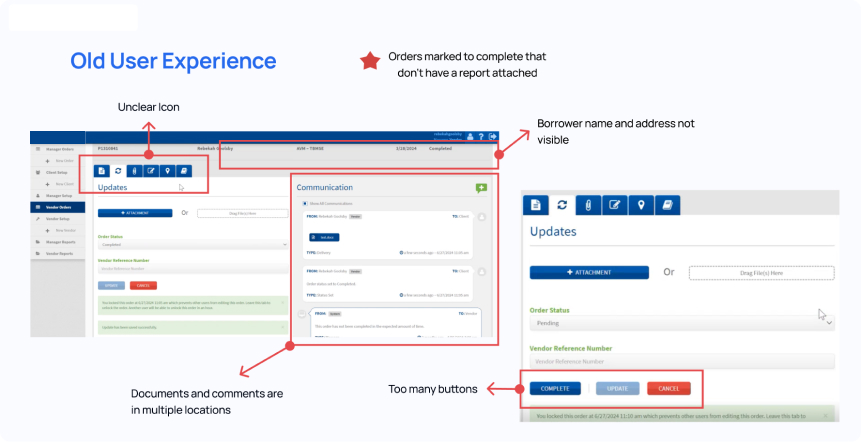
Fig 1. The existing interface suffered from unclear iconography, scattered information across multiple locations, excessive action buttons, and missing critical context like borrower details
Design Process
Enterprise Client Partnership
I embedded directly with the enterprise client's operations team to understand their workflows from the inside. Through contextual inquiry sessions, stakeholder interviews, and process mapping workshops, I uncovered the gaps between what the platform offered and what enterprise-scale operations actually needed.
Discovery Insights
Workflow Mapping
Documented the full order lifecycle across 7 status states, revealing 3 previously invisible handoff points where orders were getting stuck or lost.
Role-Based Needs
Identified 4 distinct user roles (lender, ops coordinator, vendor, admin) each needing different views, permissions, and workflows within the same platform.
Scaling Constraints
The client's growth projection required the platform to handle 10x current volume within 6 months — every design decision had to account for scale.
Configuration Over Code
Each client needed different product types, pricing rules, and vendor assignments — requiring a configuration-driven architecture rather than hardcoded logic.
Key Design Tradeoff: Configuration Complexity vs. Simplicity
The multi-tenant architecture meant each client needed different workflows, product types, and vendor rules. The temptation was to build a simple, opinionated system. Instead, I designed a configuration-driven approach — more complex upfront, but it gave clients a self-serve tool for creating and modifying new vendors. New vendors could onboard in days instead of weeks of engineering work. The bet paid off: clients can edit and add new vendors as needed without any architectural rework or engineering effort from our side.
Product Trio+ Methodology
I championed a Product Trio+ approach — design, product, and engineering working in tight collaboration with direct client input. This wasn't a waterfall handoff; it was continuous co-creation with weekly design reviews, rapid prototyping, and real-time feedback from the operations team using the product daily.
The key insight: Traditional enterprise software design relies on requirements documents and scheduled feedback cycles. By embedding with the client and running 2-week design sprints with live prototype testing, we compressed what would typically be a 6-month discovery phase into 6 weeks — without sacrificing depth.
2-week design sprints: Each sprint delivered testable prototypes that the ops team could interact with and provide feedback on
Weekly design reviews: Cross-functional sessions with design, product, engineering, and client stakeholders to align on priorities and trade-offs
Real-time iteration: Designs were tested with live data scenarios, not hypotheticals — uncovering edge cases that spec-based design would have missed
From Foundation to Enterprise Scale
Order Management Dashboard
The redesigned order management dashboard serves as the central workspace for operations teams. It provides a unified view across all clients and tenants, with powerful filtering, search, and status tracking that scales from dozens to thousands of active orders.
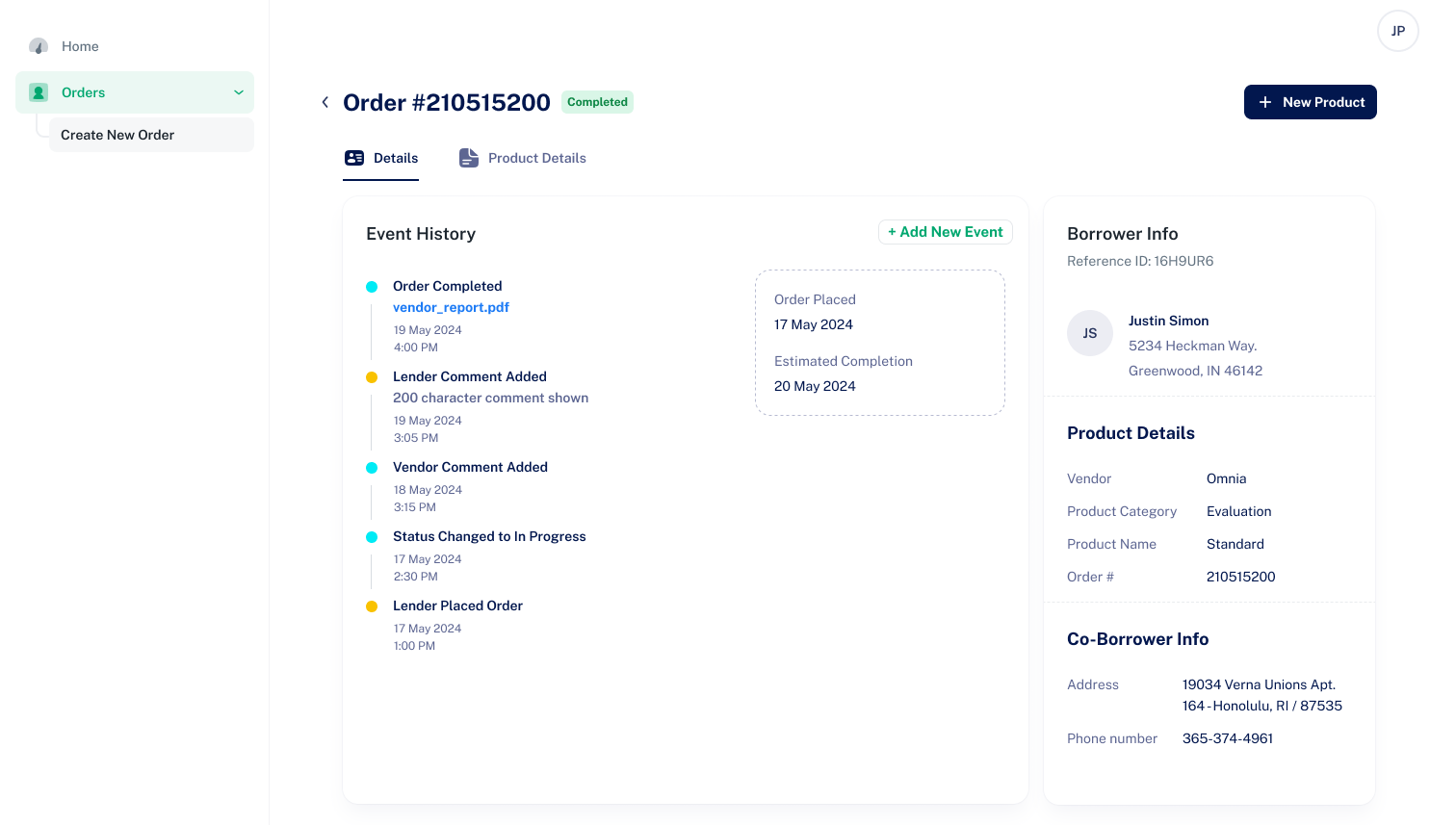
Fig 2. Order Detail view with event history timeline, borrower information, and product details
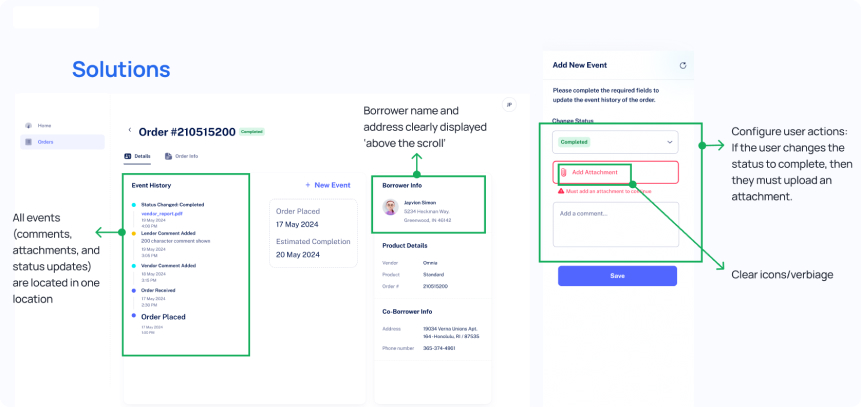
Fig 3. The redesigned experience consolidates all events in one location, surfaces borrower info above the fold, and introduces configurable user actions with clear iconography
Event history timeline: Every order action is logged chronologically — from placement through completion — creating a full audit trail without manual documentation
Multi-tenant data isolation: Each client's orders, vendors, and configurations are fully isolated while ops teams can see across tenants when needed
Status-driven workflow: Orders progress through defined states (Placed → In Progress → Completed) with automated notifications and vendor assignments at each transition
Contextual detail panel: Borrower info, product details, and vendor assignments are accessible from the order detail without leaving the page — eliminating the context switching that plagued the previous system
Scalable Design System Implementation
To support multi-tenant customization without code changes, I designed a component-based system with configurable layouts, theming, and role-based views. This allowed new clients to be onboarded in days instead of weeks, with their unique workflows configured rather than coded.
Modular components: Reusable UI components that adapt to each client's product types, statuses, and data fields through configuration
Role-based access: Four distinct permission levels ensure each user type sees only what's relevant — lenders see their orders, vendors see their assignments, ops sees everything
White-label ready: The design system supports client-specific branding and configuration, enabling each tenant to feel like a custom product while running on shared infrastructure
Results & Impact
Key Takeaways
Configuration-driven design dramatically reduced time-to-value for new clients — what previously required engineering sprints became admin-level setup
The Product Trio+ methodology compressed discovery and delivery timelines by keeping design, engineering, and client stakeholders in continuous alignment
Designing for multi-tenancy from the ground up meant the platform could absorb 720x volume growth without architectural rework
Embedding with the enterprise client's operations team surfaced requirements that traditional discovery methods would have missed — the difference between designing for how work should flow vs. how it actually flows
Innovation & Learning
This project taught me that strategic design thinking drives exponential business results. The 720x growth wasn't just about building more features — it was about designing a flexible foundation that could absorb complexity without passing it to the user. Every design decision was evaluated against the question: "Will this still work when we're processing 10x this volume?"
Future iterations would explore automated vendor matching based on performance metrics, predictive order volume forecasting for capacity planning, and deeper analytics dashboards for enterprise clients to self-serve operational insights.